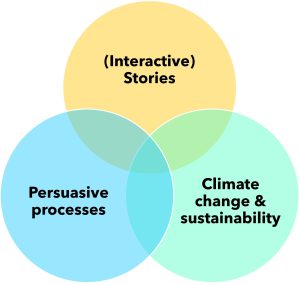
I’ve always been fascinated by the power of stories. Being an avid reader and (when I have time) enthusiastic movie fan myself, I love studying how stories can change people’s emotions, attitudes, and behavior, preferably for the better. To that end, my research interests lie in the intersection of three key themes:
Stories
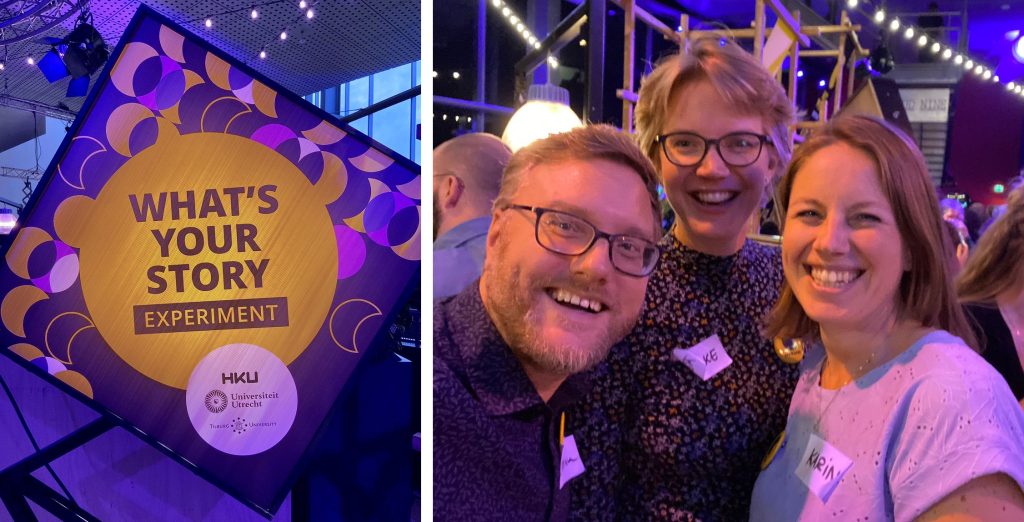
My passion for studying the effects of stories currently finds an outlet in a collaboration with Renske van Enschot (Tilburg University) and Christian Roth (HKU Utrecht University of the Arts). Together, we are making a valiant attempt to ’tame’ the wild field of interactive digital narratives and try to understand how such new stories can strategically contribute to change. This is no small feat, given the large diversity of perspectives on interactive narratives. More concretely, we conducted an audience study at the 2022 edition of the Betweter Festival called ‘What’s your story?‘. We asked festival visitors to experience existing interactive stories, created by journalists around several refugee-/immigration-related topics, and to tell us what they liked and disliked. We hope to use this input for a review on strategic interactive digital narratives (stay tuned!).
At the festival, I was interviewed by Karlijn Meinders (BNR Nieuwsradio) for a podcast called ‘Wetenschap Vandaag’. We talked about the power of a good story. Want to hear more? You can find the podcast here.
Renske and I also also collaborated on an MA-thesis project by Judith Prins, in which we studied the interactive audiovisual climate-fiction documentary De eeuw van mijn opa. In collaboration with film maker Sam van Zoest, we were able to create non-interactive versions of this documentary, in order to test whether the interactive version was more powerful than the non-interactive version in changing people’s pro-environmental beliefs, attitudes, and intentions. (Spoiler alert: it didn’t). We presented this paper at the 2023 edition of the Etmaal van de Communicatiewetenschap in Enschede.
Sustainability & climate change
I aim to use my academic powers to contribute to the most pressing problem of our time: climate change. I believe that individual behavior can meaningfully contribute to slowing down climate change, and that communication plays a key role in motivating people. This goes for strategic communication in general, but also stories in particular, because stories have a unique power to portray far and distant futures in a tangible way. Currently, I am working on a project by Tina Venema and Laura Weiss (in collaboration with MilieuCentraal) in which we aim to understand how hope and fear appeals in climate communication can play a role in the relation between sustainable behaviour and well-being in the Dutch population. Our aim is to start the data collection in the fall of 2023.
Persuasive processes
Lastly, I work on projects that aim to understand how written messages can affect people’s beliefs. I collaborate with Hans Hoeken on a project that aims to understand how processing fluency and gut feelings affect message acceptance and perceived convincingness of short written messages. In 2022, we published a theoretical paper on the Perceived Convincingness Model (together with Anita Eerland, Bregje Holleman, Jos van Berkum, and Henk Pander Maat). We are now working on empirical research in order to test our assumptions in that theoretical model.
This page was last updated on June 29, 2023.